Tuned seismic vulnerability functions
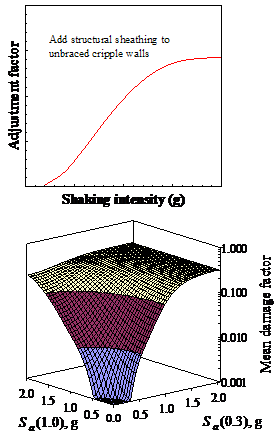
The problem: loss modeler can’t model an important building feature. Insurers sometimes have more information about building conditions than commercial loss models can handle in a strongly defensible fashion. Modelers may lack adequate historical data to distinguish the effects of important building features. An example is the effect of foundation type on the performance of woodframe buildings. Houses with unbraced cripple walls perform significantly differently from buildings with slab-on-grade construction, braced cripple walls, post-and-pier foundations, etc.
The solution: analytically derived seismic vulnerability functions and adjustment factors. We create empirically based analytical seismic vulnerability functions to reflect a specific building and adjustment factors to account for a particular condition in multiple buildings. Our vulnerability functions use either scalar or vector-based hazard measures. We use laboratory test data and a computer model that accounts for important sources of uncertainty, and create analytical seismic vulnerability relationships for buildings with and without various important features. We can create a probabilistic mix of buildings with and without a feature to represent average conditions. The modelers’ vulnerability functions–developed using historical loss data or other means–also represent average conditions, and account for claim-adjustment practices, etc. We provide a ratio: analytical vulnerability with the feature to analytical vulnerability under average conditions. The modeler multiplies its empirical average-condition seismic vulnerability function by our analytical adjustment factor and produces a with-feature seismic vulnerability function. The new function both accounts for historical loss data and the theoretical effect of the important feature.
Applications
| High-value property. A building-specific PML or other measure of risk is needed that is scientifically defensible, rather than one that is heavily reliant on expert opinion. | |
| Premium incentives for retrofit. To design an appropriate premium incentive, an insurer needs to know by how much its expected annualized loss decreases if insureds perform seismic retrofit. | |
| Specialty portfolio. An insurer underwrites a subcategory of buildings with features that make the buildings more or less vulnerable than the average building of that class. The insurer needs to know the risk for its specialty portfolio to design an appropriate reinsurance package. |
Key Benefits
| Detects small but important building features while employing defensible, empirical loss information | |
| Fully probabilistic | |
| Uses state-of-the-art next-generation performance based earthquake engineering | |
| Reflects the details of your building or your portfolio | |
| Vetted methodology developed at Stanford University and Caltech |
Available adjustment factors for wood frame construction
| Unbraced cripple walls | |
| Braced cripple walls | |
| Slab-on-grade construction | |
| Poor condition | |
| Typical condition | |
| Superior condition | |
| Single story | |
| Two stories | |
| Wood sheathed versus stucco only | |
| Concrete stem walls | |
| Hillside site (in development | |
| Post-and-pier foundations (planned) |
Available adjustment factors for steel-frame construction
| Pre-Northridge welded steel moment frame | |
| Post-Northridge welded steel moment frame |
Other structure types and conditions
| Can be developed on an as-needed basis, e.g., brick chimneys, masonry cladding, |